Large Language Models (LLM) are becoming crucial parts in automated business communications nowadays. As online businesses and digital services are emerging, the use of customers’ data and communication are also increasing. For every business small or big, it is difficult to handle the big data and customer queries manually. That’s where LLM comes in to help enterprises from drowning in the large dataset. Large Language Models are becoming common practices in business communication. From small businesses to large enterprises, LLM is helping to handle big data and customer queries.
What are Large Language Models (LLM)?
Large Language Models (LLM) are trained language models that learn and work with the big datasets. LLM acts according to the previous data set that it learned based on its own understanding process. Through LLM, answering general queries, drafting emails and making documentation has become easier and efficient. This processing is done by the computer programs that use neural networks for predicting the possible outcomes from the previous dataset. In the business sector, Large Language Models are very helpful in automated business communications.
How Organizations Managed Big Data Before LLMs
Before LLMs transformed the scene, managing big data was a manual, and resource-intensive process. Analysts spent hours combing through spreadsheets, writing SQL queries, and relying on business intelligence tools like Tableau or Power BI. These platforms needed skilled staff who could turn raw data into insights. However, the process was slow and often failed to deliver real time answers. Data was analyzed in chunks, and making sense of it required careful cleaning and sorting. Managing data was a task that took time and effort.
Traditional Approaches to Customer Queries
For customer queries, businesses leaned heavily on traditional call centers and email support. Human agents handled each question individually, which meant long wait times and growing frustration for customers. Some organizations tried using simple chatbots, but these bots could only respond with scripted answers, unable to truly understand what the customer needed. Complex questions always had to be sent to human agents, creating more work and more delays. These old-school methods worked, but they were hard to scale and often left both staff and customers feeling overwhelmed.
LLM Becoming the Gamechanger in Business Operations
Handling Big Data with LLM
LLMs completely reshape how organizations deal with big data and customer queries. For big data, LLMs make complex data accessible to everyone—not just data experts. You can ask questions in plain language and get instant insights, without needing to understand databases or analytics tools. LLMs can scan huge amounts of data, find patterns, and generate summaries that help teams make faster, better decisions.
LLM in Handling Customers
For customer queries, LLMs bring a new level of automation and personalization. They power chatbots and virtual assistants that can understand real conversations, not just pre-written scripts. These AI bots handle more questions, give better answers, and pass on complex issues to humans only when needed. As a result, wait times shrink, customers feel heard, and teams have more time to focus on what matters most.
How Big Organizations Using LLM
Big companies around the world are using LLMs to boost efficiency, enhance customer experiences, and unlock new opportunities. Tech giants like Google, Microsoft, and Amazon are weaving LLMs into their core products. For example, Microsoft has integrated LLMs into Microsoft 365’s Copilot to help users write better emails, create reports, and summarize documents with a simple prompt. Google uses LLMs in its search and customer support tools to give more accurate answers and better recommendations.
Bangladeshi companies are also using LLM in their business operations. Big companies like Grameenphone, bKash, Synesis IT, Optimizely and other companies are using LLM. In the IT industry LLM is playing a big role in Bangladesh. Synesis IT is using the LLM in their contact center solutions like 333. They are also using LLM in Convay to handle big datasets and AI features.
The Bottom Line
LLMs aren’t just another tech trend. They’re a real solution to big problems. If the businesses handle loads of data or handle many customers, LLMs can help. LLM can save a lot of time and cut costs. LLM makes life easier for businesses and their customers. Want to stay ahead in 2025 and beyond? Start exploring what LLMs can do for you. Because the way we work, talk, and serve is changing. And LLMs are leading the way.
The whole world is embracing Artificial Intelligence, so the Bangladeshi government is. The government is adapting AI in efficiency, transparency, and citizen engagement. This transformation is very necessary to leverage information and communication technologies to deliver public services seamlessly. Synesis IT PLC is playing a key role in assisting Bangladeshi government in efficient official & citizen engagement through AI. By integrating Artificial Intelligence (AI) into its e-Governance solutions, Synesis IT is redefining how governments interact with citizens, streamline operations, and foster innovation. Synesis IT: A Pioneer in e-Governance
Founded in 2006, Synesis IT has grown into one of Bangladesh’s most respected ICT organizations with qualified employees. The company has empowered governments and enterprises through scalable, innovative solutions in areas like e-Governance, Health-tech, Fintech, Contact Center, and more. With a proven track record of over 60 large-scale e-Governance projects, Synesis IT has touched millions of lives by bridging the gap between citizens and public services. Their commitment to excellence is evident in its AI-driven initiatives, which prioritize accessibility, efficiency, and user satisfaction.
Synesis IT’s AI Based Solutions in e-Governance
There are multiple e-Governance solutions where Synesis IT has incorporated Artificial Intelligence. These AI powered solutions have made the government services more structured and efficient. Here are some solutions where Synesis IT has incorporated AI in e-governance solutions.
AI in Unified Communication Tool Solution
Synesis IT has introduced the Unified Communication platform as a solution of virtual communication for everyone. It is a powerful virtual conferencing and collaboration platform designed to simplify communication for businesses, governments, and educational institutions. With its comprehensive suite of features the platform makes it easier than ever to connect and collaborate anytime, anywhere. Moreover, UC Tool has become more robust with it’s AI powered features. There are multiple features that are built with the use of AI to make the platform more user-friendly.
Automated meeting minutes: AI-driven automated meeting minutes capture discussions in real time, generating accurate, searchable summaries. This eliminates the need for manual note taking, allowing participants to focus on strategic decision making. The system also categorizes action items and assigns responsibilities, ensuring accountability and follow-ups.
Multilingual transcription: It is another game-changer, for collaboration in different languages. The platform transcribes meetings in real time with the help of AI, enabling participants to translate into multiple languages like English, Bengali, French, Spanish, Portuguese, etc. This ensures that there is no language barrier, making governance more inclusive and accessible to diverse stakeholders.
Voice denoising: This feature enhances audio quality by filtering out background noise, ensuring crystal-clear communication even in challenging environments. Whether it’s a virtual meeting with rural stakeholders or a high-stakes policy discussion, this feature guarantees seamless interactions with the help of this AI powered feature.
The platform’s scalability and integration capabilities make it ideal for governments of all sizes. It connects with existing systems, supports real-time collaboration, and ensures data security through robust encryption. By fostering efficient communication, Synesis IT’s Unified Communication Tools empower governments to make informed decisions quickly.
AI in Contact Center Solutions
Synesis IT’s contact center solutions leverage AI to simplify the services, making them more citizen-centric and responsive. By integrating AI-powered chatbots, the contact centers offer 24/7 support, answering multiple queries. 333 and Smart Land Services have integrated AI power features in their solutions.
These chatbots are designed to understand and process natural language, ensuring that citizens can interact effortlessly. For instance, any citizens in a remote village can ask about land ownership documents, and the chatbot provides clear, accurate responses. This multilingual capability, combined with context-aware processing, enhances accessibility and reduces the burden on manual support systems.
Moreover, these contact centers use AI to analyze incoming queries, identifying common pain points and trends. This data-driven approach enables government agencies to optimize processes, address systemic issues, and improve service delivery. By automating routine tasks, Synesis IT’s solution frees up human agents to handle complex cases, ensuring a balanced and efficient workflow.
AI in National Job Portal
The National Job Portal is another flagship e-Governance initiative where Synesis IT’s AI expertise shines. Designed to streamline public sector recruitment, the portal uses AI to ensure fairness, efficiency, and transparency in the hiring process. Two standout features are AI-powered proctoring for exams and chatbot support for candidates.
Online exams are increasingly popular, but ensuring their integrity is a challenge. Synesis IT’s AI-driven proctoring system monitors candidates in real time, detecting suspicious activities like unauthorized device usage or irregular behavior. Using advanced algorithms, the system flags potential violations without disrupting the exam experience. This not only upholds the credibility of the recruitment process but also reduces the need for physical invigilation, saving time and resources.
The portal’s AI chatbot is equally transformative. It guides candidates through every step of the application process, from registration to exam preparation. Available 24/7, the chatbot answers queries about eligibility criteria, application deadlines, and exam formats in multiple languages. By automating these interactions, Synesis IT ensures that candidates have equal access to information and support.
Impacts of Synesis IT’s AI Based Solutions
Synesis IT’s AI-driven e-Governance solutions are distinguished by their design, scalability, and commitment to inclusivity. By offering multilingual, 24/7 support through chatbots and accessible platforms, Synesis IT ensures that underserved communities can access public services effortlessly. Moreover, AI automation reduces manual workloads, minimizes errors, and enhances process transparency, fostering trust in governance. Looking ahead, Synesis IT aims to expand its AI-driven solutions globally, empowering governments to navigate the complexities of digital transformation. With a legacy of innovation and a commitment to social impact, the company is poised to continue changing millions of lives through technology.
Conclusion
Synesis IT’s AI-driven approach to e-Governance is a testament to the power of technology to solve real world challenges. By leveraging AI in Contact Centers, the National Job Portal, and Unified Communication Tools, the company is making the government more accessible, efficient, and inclusive. As Bangladesh and the world embrace digital transformation, Synesis IT’s solutions serve as a blueprint for how AI can drive meaningful change in the public sector.
Cyber threats are evolving at lightning speed, and traditional security measures are struggling to keep up. The increasing sophistication of attacks—ransomware, phishing scams, zero-day exploits—demands more advanced, intelligent defense mechanisms. This is where Artificial Intelligence (AI) and Machine Learning (ML) step in, offering smarter, faster, and more proactive ways to secure your digital environment.
For organizations looking to strengthen their cybersecurity posture, especially with trusted partners who understand the local and global threat landscape, integrating AI and ML isn’t just an option—it’s a necessity.
The Growing Need for Intelligent Cybersecurity
As businesses expand their digital footprint, managing cloud systems, remote teams, and vast data flows, their exposure to cyber threats multiplies. Traditional security methods—manual monitoring, rule-based detection—are no longer sufficient against sophisticated attacks. AI and ML bring agility to this space by analyzing vast datasets in real time, detecting patterns, and identifying threats long before they can cause damage.
Organizations working with experienced technology partners benefit from tailored solutions that align AI-driven cybersecurity tools with their specific risks and compliance needs.
How AI and ML Strengthen Cybersecurity
1. Real-Time Threat Detection AI and ML systems monitor network traffic and user behavior continuously, flagging unusual activities instantly. This proactive detection drastically reduces response time.
2. Predictive Analytics Machine learning models use historical data to predict potential vulnerabilities, enabling teams to address weaknesses before they’re exploited.
3. Automated Incident Response AI-powered systems can automate responses to certain threats, neutralizing attacks within seconds and minimizing operational impact.
4. Adaptive Learning With every new threat, AI and ML systems evolve, becoming smarter and more effective over time.
5. Enhanced Fraud Prevention AI can analyze transaction patterns to detect anomalies, helping prevent financial fraud and data breaches across industries.
Why Work with Experts to Implement AI-Powered Cybersecurity
While AI and ML tools are powerful, their real strength lies in how they’re implemented. Collaborating with cybersecurity partners who bring both technical expertise and strategic insight ensures solutions are aligned with your business goals and industry regulations.
Partners like Synesis IT help organizations navigate the complexity of AI-driven security, from selecting the right tools to integrating them with existing systems and maintaining continuous improvements. With a deep understanding of both emerging technologies and evolving threat landscapes, Synesis IT supports businesses in building robust, future-proof defenses.
AI and ML are reshaping the future of cybersecurity, offering organizations a smarter way to anticipate, detect, and neutralize threats. By combining advanced technologies with expert guidance, businesses can stay one step ahead of cybercriminals and protect what matters most.
If your organization is looking to enhance its cybersecurity framework, leveraging AI and ML with the support of trusted partners ensures you not only address today’s challenges but also prepare for tomorrow’s.
Enterprises are under more pressure than ever to move faster, work smarter, and deliver more value with fewer resources. Traditional automation helped businesses streamline repetitive tasks, but Artificial Intelligence (AI) is taking things to an entirely new level.
AI is not just automating processes—it’s transforming how enterprises operate, innovate, and compete.
Smarter, Faster Decision-Making
Unlike traditional automation that follows fixed rules, AI can learn from data, recognize patterns, and make predictions. This capability enables businesses to make smarter, data-driven decisions at speed. Whether it’s forecasting demand, optimizing supply chains, or personalizing customer experiences, AI helps enterprises stay ahead of the curve.
Personalization at Scale
One of the most powerful impacts of AI is its ability to deliver highly personalized experiences at scale. AI-driven systems can analyze vast amounts of customer data in real time and adjust interactions accordingly, leading to deeper engagement, improved satisfaction, and higher loyalty rates.
Efficiency and Cost Reduction
AI automates not just routine tasks but also complex workflows that previously required significant manual oversight. From intelligent document processing to automated customer service, AI enables teams to focus on high-value strategic work while reducing operational costs.
Continuous Learning and Adaptation
Traditional automation systems are static—they require manual updates to improve. In contrast, AI systems continuously learn and adapt. They get better over time, optimizing processes, identifying new opportunities, and responding to changes in the environment without constant human intervention.
Proactive Risk Management
In fields like finance, healthcare, and cybersecurity, AI’s ability to detect anomalies, predict risks, and automate compliance checks is becoming indispensable. Enterprises can now prevent issues before they arise, ensuring greater resilience and security.
Final Thoughts
AI is not just enhancing enterprise automation—it’s reshaping it entirely. By combining speed, intelligence, and adaptability, AI empowers organizations to innovate faster, serve customers better, and build more resilient operations.
Many forward-thinking companies are already exploring AI-driven strategies to stay competitive. Organizations like Synesis IT, for example, support enterprises in their journey toward smarter automation and digital transformation through a range of flexible services, including staff augmentation and tailored technology solutions.
As we look toward the future, it’s clear: AI isn’t just a tool—it’s a strategic advantage.
Cloud computing is rapidly shifting the IT infrastructure of businesses. Nowadays, companies are heavily dependent on cloud computing for storing their data through online services. As cloud computing offers flexibility, scalability, and cost efficiency, the demand for bulky servers and expensive on-premise hardware is fading out. Cloud computing is the starting of the future of more advanced IT infrastructure.
What is Cloud Computing?
Cloud computing refers to different computing services via the internet. Computing services like storage, databases, networking, software, and analytics can be handled virtually through cloud computing. It is a pay as you go service. Cloud service providers like Amazon Web Services (AWS), Microsoft Azure, and Google Cloud empower businesses to access these resources whenever they need them, eliminating the need for physical hardware. Bangladesh’s leading software company Synesis IT is also building their own cloud server. Before cloud computing technology, companies needed to rent or buy on-premises setup to maintain and store data. Thanks to cloud computing, companies now can easily store and maintain their data with lower cost.
Cloud Computing Models
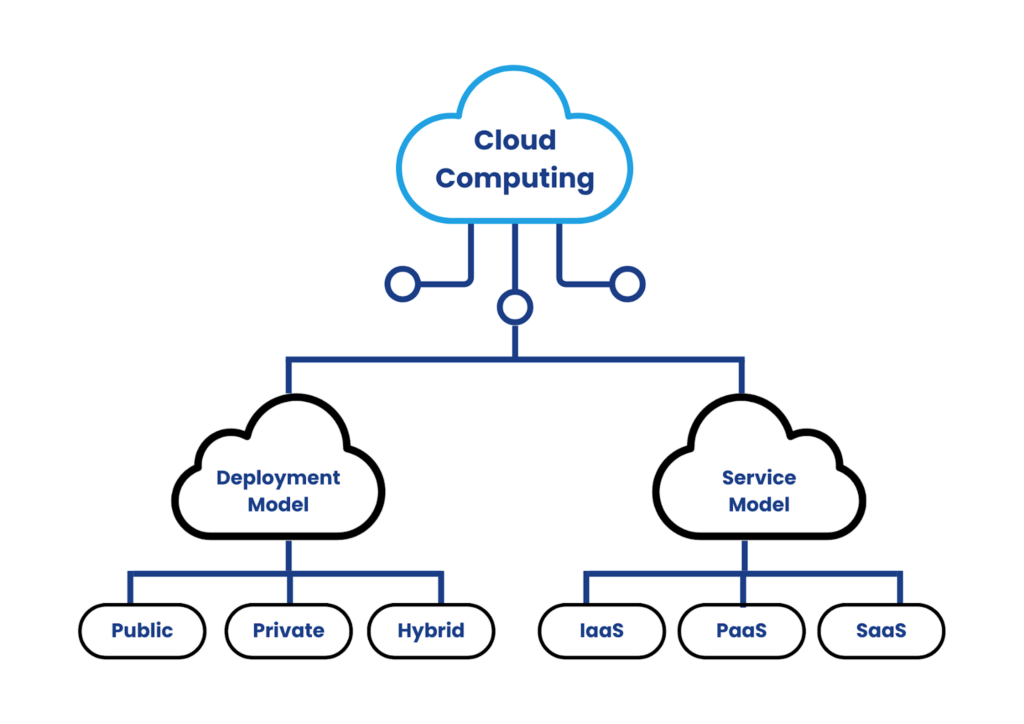
There are two models of cloud computing. Deployment models and Service Models. These models are divided into other sub models.
Deployment Models
Deployment models in cloud computing refer to the structure of cloud structure and the authority over the resource management. These models determine where the cloud resources are located and who can access and manage them. There are 3 types of deployment models.
1. Public Cloud: Here, the cloud infrastructures are available to many people. The cost of public cloud is cheaper than the others. These public clouds are owned by the cloud providers like AWS, Microsoft Azure and other cloud providers.
2. Private Cloud: This cloud infrastructure is accessed and organised by a specific organization. Only that organization can operate with that cloud service.
3. Hybrid Cloud: This cloud is the mixture of both private and public cloud. Users can enjoy the combination of both service features through this model.
Service Models
Service models determine the level of control of cloud servers. These models determine how the cloud servers can give services towards customers. Service models are as well categorized into 3 types.
1. IaaS: Infrastructure as a service or IaaS is a cloud service model where users can access basic computing infrastructure. It is often used by IT administrators for accessing only storage or virtual machines. But they will have to manage data, applications and middleware.
2. PaaS: Platform as a Service or PaaS provides cloud platforms runtime for developing, managing and testing applications. This model offers customers to deploy applications without acquiring or managing. Customers only have to manage applications and data.
3. SaaS: Software as a Service or SaaS offer hosting and managing applications for clients. Here everything is managed by the service provider.
Impact of Cloud Computing in IT Infrastructure
Cloud computing has changed the way of managing and handling big datasets. Nowadays, every organization is dependent on cloud services. There are many reasons why cloud computing is more effective than other ways of managing data.
Cost Efficiency & Scalability
Traditional IT infrastructure requires heavy upfront investments in hardware and maintenance. Cloud computing eliminates these costs by offering pay-as-you-go models. It helps businesses to scale resources up or down based on demand.
Enhanced Security & Compliance
Cloud providers invest heavily in security. Thus they can offer advanced encryption, identity management, and compliance certifications. This makes cloud infrastructure more secure than many on-premise setups.
Remote Work & Collaboration
With cloud-based tools like Microsoft 365 and Google Workspace, teams can collaborate in real time from anywhere. This shift has become essential in the era of remote and hybrid work.
Disaster Recovery & Business Continuity
Cloud computing ensures data is backed up and recoverable in case of hardware failure, cyberattacks, or natural disasters. Manually, data recovery process is very difficult.
AI & Big Data Integration
Cloud platforms provide the computing power needed for AI, machine learning, and big data analytics. Businesses can leverage these technologies without investing in expensive hardware.
That’s how cloud computing is impacting the IT infrastructure for different industries. In Bangladesh, Synesis IT is helping modernize how businesses and public services use technology in Bangladesh. Synesis IT provides cloud-based solutions for everything from government e-services to enterprise-level apps. By helping organizations shift to the cloud, Synesis IT enables them to reduce costs, improve service, and prepare for a digital future.
The Future of Cloud Computing
As cloud computing technology is updating day by day, there are huge possibilities in this sector. Also, the providers are adopting renewable energy to reduce carbon footprints. Moreover, quantum technology can be also integrated with cloud computing. Companies like IBM are making quantum computing accessible via the cloud.
Cloud computing is the future of IT infrastructure. From cost savings and scalability to AI integration and remote work support, cloud computing empowers organizations to innovate and grow efficiently. As technology evolves, companies that invest in cloud computing today are building a strong foundation for tomorrow. Whether you’re a startup or an enterprise, now is the time to leverage the cloud computing based IT strategy.